
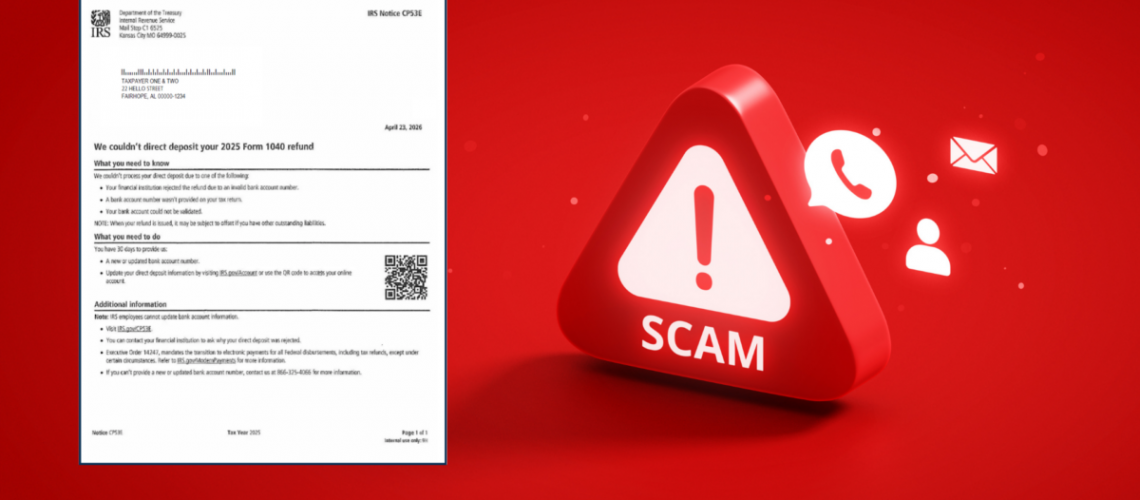
There is a new scam that targets taxpayers who did not provide direct deposit information on their tax returns. Scammers are sending notices that falsely appear to come from the Internal Revenue Service (IRS) in an attempt to steal bank account information. In this scam, the taxpayer receives a IRS CP53E, which is a legitimate IRS form, but the instructions for submitting bank information are altered to direct the information to a scammer instead of the IRS. These notices are being issued to taxpayers who did not even get a refund, so regardless of whether you’re waiting on money from the IRS, you provided your bank account information, or you are an intended target, you should be on alert.
IRS Notice CP53E Refund Scam Background
On March 25, 2025, President Trump signed an executive order requiring all federal agencies to cease the use of paper checks. To comply, the IRS encouraged taxpayers to submit direct deposit information on their tax returns. The executive order intended to reduce stolen refunds and make things run more smoothly, but the quick shift from paper checks to direct deposits created a new process for noncompliant filers that created an opportunity for scammers to send fake notices and try to steal personal and financial information.
To discourage paper checks, the IRS shared that taxpayers who did not provide their banking details on their returns would need to take additional steps and wait longer before a refund would be issued. The first extra step is that if you did not provide banking details on your return, the IRS will send you a CP53E notice using your last-known address on record asking you to update your bank account information.
The CP53E notice requests that you provide banking details within 30 days and as soon as you respond, you can expect an immediate deposit. If you do not respond, the IRS has up to 6 additional weeks before cutting a paper check.
Adding to this, informal reports from IRS Service Centers indicate that the IRS may have inadvertently programmed its systems to issue Notice CP53E to certain taxpayers who did not request a refund on their 2025 federal income tax return.

How to Spot an IRS CP53E Notice Scam
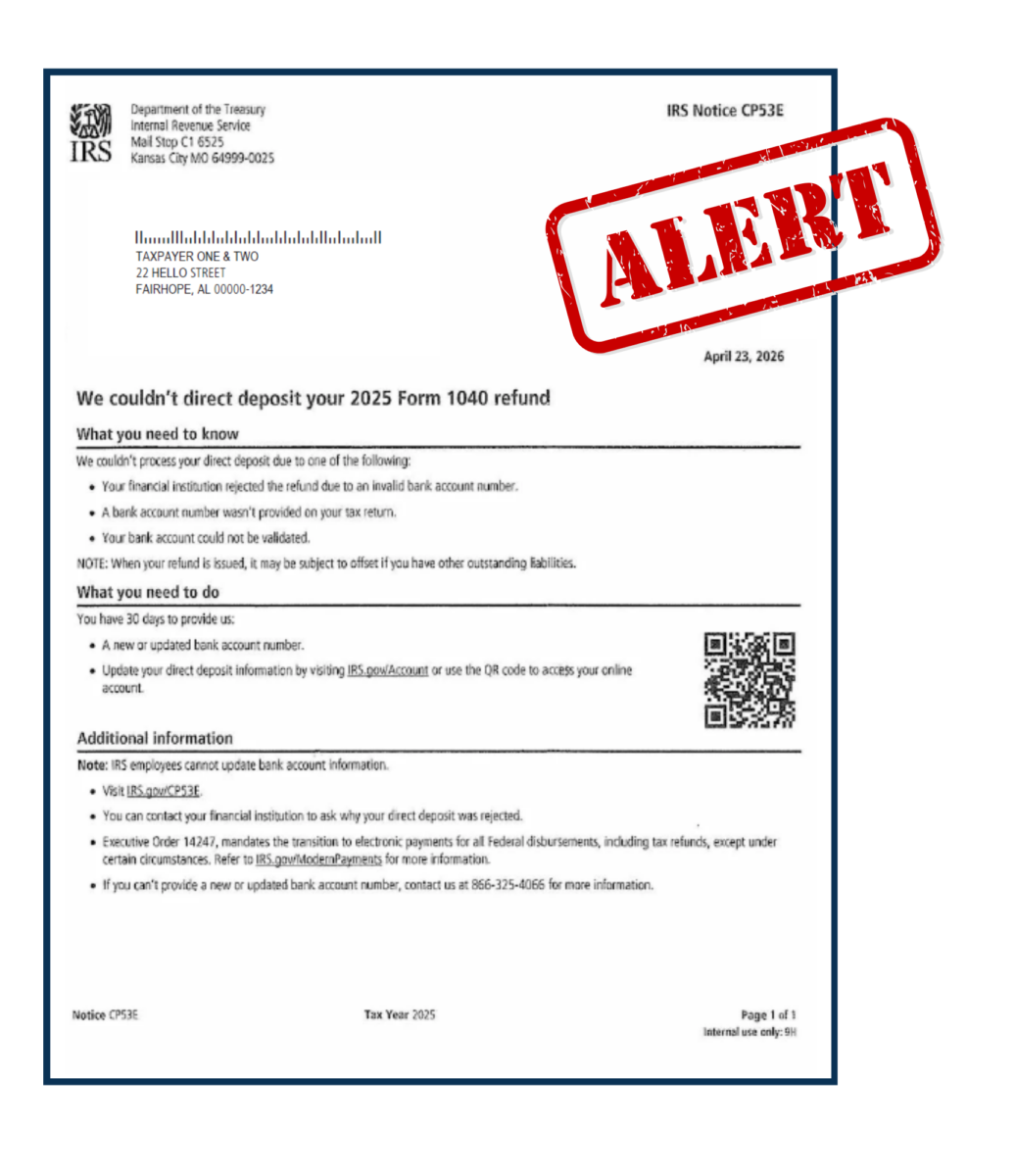
The CP53E notice is a legitimate notice (like the one pictured here) that some taxpayers should be expecting to receive, but even if you get one, you should take extra precautions to ensure you are responding to a legitimate IRS letter. A legitimate CP53E requests that you establish an online account with the IRS and add in your banking details. The IRS will not contact you by phone, text, or email offering to “help” update your online account information – anyone who does is not legitimate.
A fake notice may include the following:
- Directions to go to a non-IRS.gov website;
- Telephone numbers not associated with the IRS;
- A QR code to a scam website;
- An option to receive your refund via a gift card, etc.; or
- A request to respond via email or text message, which are methods the IRS does not use for initial taxpayer contact.
What to do if you Receive an IRS CP53E Notice
If you are a client of Avizo, we always encourage you to call our office and provide a copy of any notice you receive from the IRS. We can respond on your behalf, or even just review it to let you know if your letter is legitimate. Clients who selected audit support receive this with no additional cost.
Other taxpayers should consider the following steps:
- Do NOT update your banking information immediately.
- Do NOT scan any QR codes/visit a website provided, do NOT call a provided number, and do NOT email a provided email addresses. Instead, do these:
- QR Code/Website: Go to the official IRS website, www.irs.gov and search for “online account” (or come back to this blog and click that link).
- Phone: The IRS fraud phone number is 800-829-1040. You can also look up an IRS phone number on www.irs.gov – but do not call the number provided in the letter.
- Email: There is no email address that is legitimate upon a first notice. Do not email.
- DO review your tax returns to confirm whether a refund is due – if a refund is due, create your online account to confirm the status of your refund.
- DO Report the fraudulent letter to the IRS.

Taylor Clinkenbeard, CPA
Taylor is a Manager in our tax and client accounting services teams. She has developed specific expertise in software, accounting processes, and tax laws to serve our clients.
